
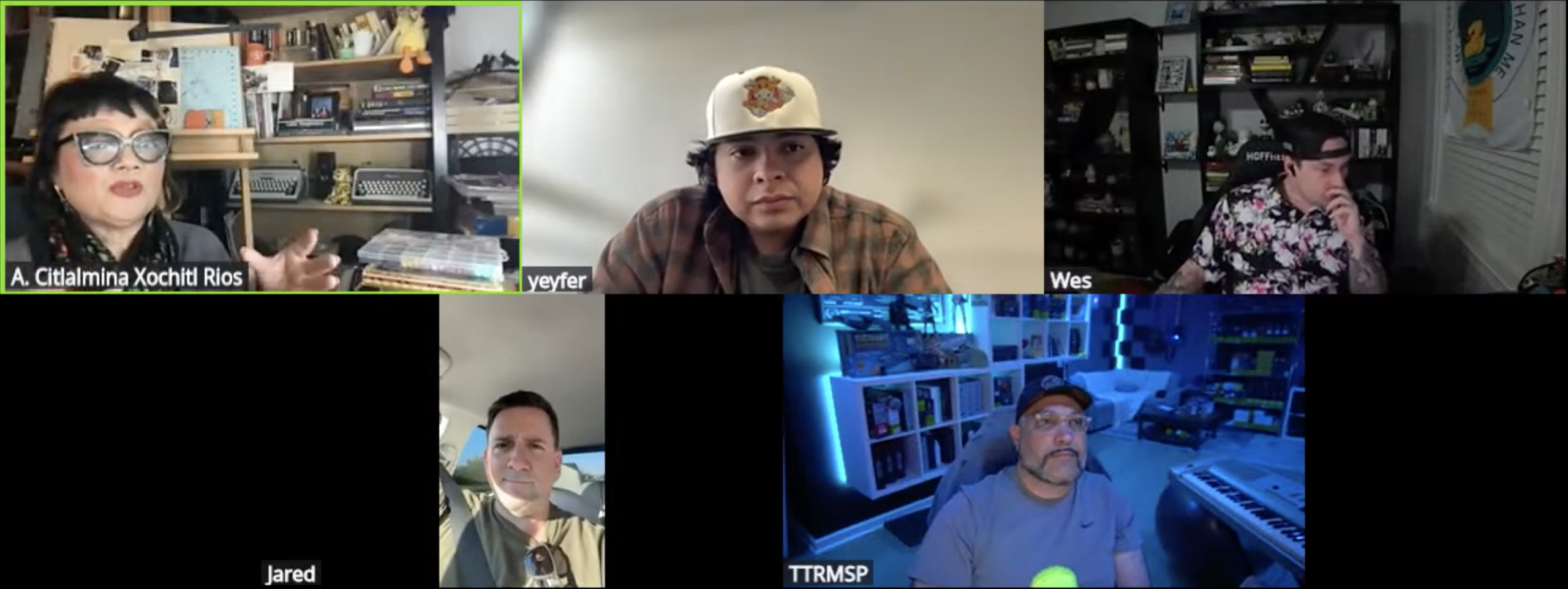
On March 12, Student Veterans of America students joined leaders from American Legion Gaming for a virtual fireside chat that explored how video games can build community, strengthen leadership skills, and connect Veterans across distances.
The Zoom discussion brought together Marine Corps veteran Citalamina Xochitl Rios, Navy veteran Wes Lewison, student veteran Yeyfer Adrade, and Marine Corps veteran Jared Morgan, CEO of American Legion Gaming. The conversation focused on how gaming can create meaningful connections for Veterans and students transitioning into civilian life.
Rios opened the discussion by sharing her own relationship with gaming. While she said she would not normally call herself a gamer, video games have played an important role in her family and her curiosity about leadership development.
“I wouldn’t consider myself a gamer, but I do have a long history with gaming,” Rios said, explaining that she first played classic titles like Centipede and Frogger before later exploring newer games with her children. “I used gaming as a way for my children to learn to write and communicate and do problem solving.”
Her interest deepened after attending a Student Veterans of America leadership program, where she began researching how gaming might connect to leadership training and Veteran support.
Lewison, who serves as Chief Marketing Officer for American Legion Gaming, explained that gaming communities often create real friendships and teamwork that extend far beyond the screen.
One of his earliest memories of gaming’s impact came while playing Fallout. He recalled seeing fellow service members gather after their shifts to talk about the game and help each other navigate challenges.
“I really saw it expand past the screen for the first time,” Lewison said. “People were bringing their computers and consoles together to give each other advice and connect.”
For Yeyfer, gaming has been a lifelong passion that began in childhood and continued through his military service and college experience.
“Video games have been there my whole life,” he said. “It’s helped me in so many ways. It’s something anyone can enjoy, and there’s something there for everyone.”
Yeyfer described how certain games, particularly tactical and team-based titles like Battlefield, helped him develop skills that carried over into the military. Many games require players to take on specific roles and coordinate with teammates to accomplish a shared goal.
“In a lot of games, there are roles and classes,” he said. “You have to plan accordingly and communicate. The more unified your team is, the better you are.”
Morgan said those same cooperative elements are part of what inspired the creation of American Legion Gaming, a program designed to bring Veterans together through online communities and esports-style events.
He pointed to games such as Squad, which require coordinated leadership and communication between multiple players to succeed.
“You have a squad of ten, and you can’t win without teamwork,” Morgan said. “If you don’t know the rules of the game, you can’t lead.”
Beyond gameplay, the conversation also touched on the ways gaming friendships can translate into real-world connections. Several panelists shared stories of meeting fellow players online and later discovering they served in the same military units or were stationed nearby.
Lewison recalled meeting a friend online through gaming before realizing they were both serving in the Navy and stationed only blocks apart.
The panel also discussed how gaming communities can help student Veterans who may feel isolated on college campuses. Rios stated that some Veterans hesitate to identify themselves at school, particularly if campus culture feels unwelcoming. Gaming groups and esports teams can provide another entry point into Veteran communities.
American Legion Gaming leaders hope discussions like this one will encourage more student veteran organizations to explore gaming as a tool for connection, leadership development, and recruitment.
As the event wrapped up, participants emphasized that gaming is no longer just a hobby. For many Veterans, it is a platform that supports teamwork, communication, and community.
“It’s just another way of connecting with people,” Yeyfer said. “And sometimes those connections can last a lifetime.”
The full fireside chat can be viewed on YouTube at https://www.youtube.com/live/zvR0iI5PuV4?si=F5LwFK-W2ePV5vNo
RELATED ARTICLE: AMERICAN LEGION GAMING CREATES CONNECTION AT SVA NATIONAL CONFERENCE





0 Comments